

-
1 multiblast high-speed developing
English-Russian mining dictionary > multiblast high-speed developing
-
2 camera
2) киносъёмочный аппарат, киноаппарат, кинокамера6) архит. сводчатое покрытие•to thread camera — заряжать киносъёмочный аппарат- 6×6 cm camera -
accelerated motion-picture camera
-
aerial camera
-
aerophotographic camera
-
all-sky camera
-
amateur camera
-
animation camera
-
astrographic camera
-
astronomical camera
-
auto camera
-
autofocusing camera
-
autoprocess camera
-
background camera
-
ball camera
-
ballistic camera
-
battery-powered camera
-
bellows-type camera
-
bellows camera
-
bipack camera
-
blimped camera
-
borehole camera
-
box-type camera
-
box camera
-
broadcast camera
-
caption camera
-
cartographic camera
-
cartoon camera
-
cartridge loading camera
-
cartridge camera
-
cassette camera
-
CCD camera
-
cine camera
-
cinefluorographic camera
-
cinematographic X-ray recording camera
-
cineradiology camera
-
closed-circuit TV camera
-
close-up camera
-
cloud camera
-
collapsible camera
-
color camera
-
color television camera
-
color-slide camera
-
combination single film camera
-
compact-size camera
-
composite electronic and film camera
-
continuous-motion camera
-
copying camera
-
copy camera
-
darkroom camera
-
data-recording camera
-
Debye-Scherrer camera
-
deep-water camera
-
discontinuously writing camera
-
documentary camera
-
double-eight camera
-
double-extension camera
-
double-frame camera
-
drum camera
-
dual-gage camera
-
easily handled camera
-
EFP camera
-
electric eye camera
-
electric-driven camera
-
electric camera
-
electronic camera
-
electron camera
-
electronic news gathering camera
-
endoscopic camera
-
ENG camera
-
environmentally protected camera
-
fast pulldown camera
-
field camera
-
film camera
-
film developing camera
-
film recording camera
-
fixed camera
-
fixed-focus camera
-
fixed-pin registration camera
-
flash camera
-
flow camera
-
folding camera
-
foreground camera
-
framing camera
-
full-frame format camera
-
gallery camera
-
graphic arts camera
-
graphics camera
-
grid camera
-
ground glass focusing camera
-
ground glass camera
-
Guinier camera
-
gyroscope camera
-
half-format camera
-
hand camera
-
hand-held camera
-
HDTV camera
-
high-frequency camera
-
high-resolution camera
-
high-speed camera
-
hologram camera
-
horizontal camera
-
image compensation camera
-
image-converter camera
-
image-dissection camera
-
industrial-type camera
-
industrial camera
-
industrial-type television camera
-
industrial television camera
-
infrared camera
-
instant camera
-
instant-load camera
-
instrumentation camera
-
interchangeable camera
-
intermittent camera
-
Kerr cell camera
-
kinescope recording camera
-
kinescope camera
-
large-format camera
-
laser camera
-
Laue camera
-
left-eye camera
-
lenticular screen camera
-
live camera
-
log camera
-
low-speed recording camera
-
low-speed camera
-
magnetic video camera
-
manual camera
-
mapping camera
-
mask camera
-
measuring camera
-
medium format camera
-
microfiche camera
-
microfilm camera
-
miniature camera
-
monoblock camera
-
monochrome camera
-
motion-picture camera
-
motor-driven camera
-
movie camera
-
moving-image camera
-
narrow-gage camera
-
newsreel camera
-
news camera
-
one-piece camera
-
one-tube camera
-
optical compensation camera
-
outside broadcast camera
-
overhead camera
-
paging camera
-
panoramic camera
-
photo-finish camera
-
photogrammetric camera
-
photographic camera
-
photomechanical camera
-
photomicrographic camera
-
photoreproduction camera
-
photostat camera
-
phototheodolite camera
-
pickup camera
-
picosecond framing camera
-
picture-taking camera
-
picture camera
-
pilot camera
-
pinhole camera
-
plain camera
-
planetary camera
-
plate camera
-
platemaker camera
-
plotting camera
-
pocket camera
-
portable camera
-
precision camera
-
press camera
-
process camera
-
professional camera
-
programmed camera
-
projecting camera
-
rangefinder camera
-
recording camera
-
reduction camera
-
reflex camera
-
reporter camera
-
reproduction camera
-
right-eye camera
-
robot camera
-
rotary camera
-
Sauter camera
-
scanning camera
-
scientific camera
-
seismic camera
-
self-contained camera
-
self-developing camera
-
self-threading camera
-
semiautomatic camera
-
shoulder-operated camera
-
shoulder camera
-
silent camera
-
single-film camera
-
single-frame camera
-
single-lens reflex camera
-
slate camera
-
slave camera
-
slow-motion camera
-
sound motion-picture camera
-
sound-film camera
-
sound-on-film camera
-
spectrographic camera
-
stand camera
-
step-and-repeat camera
-
stop-motion camera
-
streak camera
-
studio camera
-
subminiature camera
-
taking camera
-
technical camera
-
telecine camera
-
television camera
-
time-lapse motion camera
-
time-lapse camera
-
topographical camera
-
traveling matte camera
-
trick camera
-
twin-lens camera
-
two-piece camera
-
vertical process camera
-
video camera
-
video still camera
-
view camera
-
viewfinder camera
-
Weissenberg camera
-
wide-angle camera
-
X-ray diffraction camera
-
X-ray camera -
3 unit
1) сборочная единица; узел; блок2) установка; агрегат3) единица, единица измерения || единичный; удельный4) часть; секция || секционный•as a unit — 1) в сборе 2) как единая сборочная единица; как единый узел
unit under test — 1) объект контроля 2) объект диагностирования, объект технического диагностирования
- AC unit- actuating unit
- adapter plate unit
- adaptive control unit
- address and data interface unit
- address unit
- adjusting unit
- air-aspirating unit
- answer-back unit
- arithmetic unit
- arithmetic/logic unit
- arithmetical unit
- ASC unit
- assembly unit of N-order
- assembly unit
- audio response unit
- autoloading unit
- automatic calling unit
- auxiliary data translator unit
- availability control unit
- axis unit
- axis-processing unit
- balancer unit
- banking unit
- bar feed unit
- base assembly unit
- base unit
- basic information unit
- basic length unit
- basic logic unit
- batch control unit
- bearing unit
- behind-the-tape reader unit
- belt shuttle unit
- belt-driven shuttle unit
- bench-testing unit
- blemished unit
- bolt-on unit
- booster unit
- boring spindle unit
- boring unit
- boring-and-milling unit
- brake unit
- broach retriever unit
- broach-handling unit
- broken tool sensing unit
- buffer unit
- building-block machining unit
- bulk transfer unit
- business unit
- card punching unit
- carousel loading unit
- carousel unit
- carrier unit
- cartridge unit
- cellular unit
- center unit for machine frame
- central processing unit
- central processor unit
- chain storage unit
- changer unit
- changing unit
- check unit
- chiller unit
- chip disposal unit
- clamping unit
- claw unit
- CNC machining unit
- CNC standard unit
- CNC unit
- coating application unit
- coating removal unit
- coherent unit
- column unit
- combination valve unit
- command unit
- communications central processing unit
- complementary unit
- computerized numerical control unit
- condensing unit
- cone variable-speed friction drive unit
- console unit
- constant coefficient unit
- constant delay unit
- construction unit
- control unit
- controlling unit
- conveying unit
- conveyor unit
- coolant management unit
- coolant recovery unit
- coolant unit
- cooler unit
- cooling unit
- coordinate preprogramming unit
- copying unit
- correction unit
- cover unit
- CPC handling unit
- cross tapping unit
- cross-slide unit
- cutoff unit
- cutting unit
- D unit
- damping unit
- data preparation unit
- data transmission control unit
- deep hole boring unit
- delay unit
- derived unit
- detecting unit
- detection unit
- developing unit
- digital display unit
- digital readout unit
- digital unit
- dimension readout unit
- diode array unit
- disk-type variable-speed friction drive unit
- displacement unit
- display unit
- distance-keeping unit
- double-acting unit
- double-notching unit
- double-pump and combination unit
- double-pump unit
- double-reduction gear unit
- double-reduction right-angle reduction gear unit
- double-reduction twin gear unit
- double-reduction twin unit
- double-reduction wormgear unit
- double-spindle unit
- down-hole internal deburrer unit
- dresser unit
- dressing unit
- drill unit
- drilling and milling unit
- drilling spindle unit
- drilling unit
- drilling/tapping unit
- drive unit
- drive/feed unit
- DRO unit
- dual work pallet shuttle unit
- dual-head laser beam unit
- dust-collecting unit
- dust-removing unit
- dynamic unit
- EDM unit
- electrical machining units
- electromagnetic unit
- electron-beam unit
- entry level dedicated unit
- environmental compensation unit
- exchanger unit
- fabricated unit
- facing unit
- fan coil unit
- feed box unit
- feed change unit
- feed drive cartridge unit
- feed unit
- feedback unit
- feed-in boring unit
- feed-out boring unit
- fetch-and-carry unit
- filtration unit
- fine boring unit
- flexible spindle units
- flexible tray unit
- floor unit
- focusing unit
- free-standing unit
- free-wheel unit
- free-wheeling unit
- frontal variable-speed friction drive unit
- functional unit
- fundamental unit
- gage control unit
- gage indicating unit
- gage unit
- gaging unit
- gas turbine starter auxiliary power unit
- gear unit
- gearbox unit
- gear-reversing unit
- grasping unit
- grinding spindle unit
- gripper unit
- guide unit
- handling unit
- hardware/software add-on unit
- harmonic drive unit
- head unit
- headstock-type workpiece holding unit
- hoisting unit
- horizontal power unit
- horizontal way unit
- hydraulic clamping unit
- hydraulic feed unit
- hydraulic power unit
- hydraulic testing unit
- hydraulic unit
- hydrostatic bearing unit
- ICAM manufacturing unit
- ICAM unit
- icon-driven control unit
- indexer/fourth axis unit
- indexing head unit
- indexing platen unit
- indexing table unit
- indexing unit
- in-die tapping unit
- information retrieval unit
- information unit
- input batch control unit
- input unit
- input-output unit
- in-system unit
- integral unit
- interface unit
- intermediate storage unit
- interpolating unit
- inverting unit
- keyboard unit
- knee-type unit
- lapping and superfinishing unit
- laser beam composition unit
- laser beam unit
- laser processing unit
- laser unit
- laser-calibration unit
- laser-source unit
- lead screw tap unit
- lexical unit
- lift unit
- lift-and-carry unit
- light unit
- linear ball bearing unit
- linear drive unit
- linear screw unit
- linear slide roller bearing unit
- linear unit
- live storage unit
- load/unload unit
- loading unit
- loading-and-unloading unit
- logic unit
- logical unit
- lubricating pump unit
- machine control unit
- machine tool control unit
- machine tooling unit
- machine unit
- machine-dedicated unit
- machining center unit
- machining head unit
- machining unit
- magnetic pickup unit
- magnetic tape unit
- manned flexible unit
- marking unit
- master unit
- material-handling unit
- MDI unit
- measurement unit
- measuring unit
- memory unit
- message display unit
- microdispensing unit
- microprocessor correction unit
- microprocessor NC unit
- microprocessor unit
- microprocessor-based unit
- microprocessor-type NC unit
- middle-level 3-D representation unit
- milling spindle unit
- minicomputer control unit
- miniload AS/RS unit
- mist coolant unit
- miter saw unit
- mobile unit
- mobile work storage unit
- modular cell unit
- modular loading unit
- modular unit
- motor unit
- motor-reduction unit
- multichannel analyzer unit
- multidrill unit
- multiple screw-driving unit
- multiple-power path gear unit
- multiple-reduction gear unit
- multiple-reduction unit
- multiple-spindle torque unit
- multipurpose machining unit
- multispindle boring unit
- multitap unit
- NC data creation unit
- NC unit
- nested gear unit
- notching unit
- nutating unit
- off-machine unit
- off-system unit
- oil coalescer unit
- oil-filled feed unit
- one stage gear unit
- one stage unit
- on-machine unit
- operation unit
- operational unit
- operator-friendly program unit
- orientation transfer unit
- output batch control unit
- output unit
- overhead gantry unit
- overhead spindle unit
- pack unit
- pallet change unit
- pallet exchange unit
- pallet shuttle unit
- pallet-pool unit
- parallel-shaft reduction gear unit
- PC expansion board unit
- PC-based CAD unit
- pendant control unit
- pendant pushbutton control unit
- pendant unit
- peripheral control unit
- peripheral processing unit
- photo-eye tracing unit
- pick-and-place unit
- pickup unit
- piece-holding unit
- pilot unit
- placement unit
- planetary gear unit
- planetary reduction gearing unit
- plant unit
- plasma-arc unit
- plasmarc unit
- platen unit
- PLC unit
- plugboard input unit
- plugboard unit
- plug-in unit
- pneumatic unit
- portable unit
- power feed unit
- power supply unit
- power train unit
- power unit
- power-generating unit
- power-tooling unit
- practical correction unit
- practical unit
- presetting unit
- pressurized air bearing unit
- primary storage unit
- probe unit
- processing unit
- production unit
- program unit
- programming unit
- propulsion unit
- pulling unit
- pump unit
- pumping unit
- pump-motor unit
- quill feed cam unit
- quill spindle unit
- quill unit
- raster unit
- readout unit
- reducing unit
- reduction gear unit
- reduction gearing unit
- reduction unit
- reed make contact unit
- regulating unit
- remote display unit
- replacement unit
- retriever unit
- right-angle milling unit
- right-angled milling unit
- robot power unit
- robot unit
- robot-transfer unit
- roller bearing unit
- roller unit
- roller-marking unit
- rotary unit
- rotating seal unit
- S unit
- scanning unit
- scheduling unit
- screen projection unit
- screwing unit
- sealed reed contact unit
- self-contained NC unit
- self-contained unit
- sensing unit
- sensor unit
- servo unit
- shankless boring unit
- sheet metal stamping automatic unit
- shop replaceable unit
- shuttle unit
- shuttle-and-lift unit
- side unit
- single-acting unit
- single-light unit
- single-reduction gear unit
- single-reduction unit
- sizing unit
- slant bed unit
- slave unit
- slide unit
- sliding table unit
- smallest replaceable unit
- spare unit
- speeder unit
- speed-increase unit
- speed-up spindle unit
- speed-up unit
- spindle box unit
- spindle cartridge unit
- spindle drive unit
- spindle unit
- stabilizing unit
- stand-alone unit
- standard build units
- starter auxiliary power unit
- static tooling unit
- steam generating unit
- stock feed unit
- storage unit
- stylus unit
- sub-multiple unit
- swing arm-mounted control unit
- tangent unit
- tapping unit
- teach control unit
- terminal control unit
- test unit
- testing unit
- thermal detecting unit
- tilting unit
- tolerance unit
- tool storage unit
- tool-presetting unit
- tool-spindle unit
- toroidal variable-speed friction drive unit
- track and store unit
- transfer unit
- transmission control unit
- transmission unit
- transmitter/receiver unit
- transport unit
- triple-reduction gear unit
- triple-reduction unit
- tuning unit
- turnaround unit
- turning spindle unit
- turnround unit
- turret unit
- twin gear unit
- twin saw unit
- twin-drive unit
- twin-screen unit
- unit of displacement
- unit of measure
- unit of measurement
- unit of physical quantity
- unit of product
- unit of work per unit of time
- unmanned machining unit
- vacuum unit
- variable coefficient unit
- variable delay unit
- variable preload bearing unit
- variable ratio unit
- variable speed unit
- variable-speed friction drive unit
- V-axis grinding unit
- V-belt variable-speed drive unit
- V-drive unit
- vertical way unit
- vibratory feed unit
- vise unit
- visual display unit
- vocal output unit
- VTL unit
- waveform gear reduction unit
- wheel-dressing unit
- wheel-head unit
- wing unit
- wing-base unit
- work storage unit
- work-holding headstock unit
- workshop video unit
- work-testing unit
- worm reduction unit
- writing unit
- yet-to-be-assembled unitEnglish-Russian dictionary of mechanical engineering and automation > unit
-
4 Du Cane, Peter
SUBJECT AREA: Ports and shipping[br]b. Englandd. 31 October 1984[br]English engineer, one of the foremost designers of small high-speed ships.[br]Peter Du Cane was appointed a midshipman in the Royal Navy in 1913, having commenced as a cadet at the tender age of 13. At the end of the First World War he transferred to the engineering branch and was posted ultimately to the Yangtze River gunboat fleet. In 1928 he resigned, trained as a pilot and then joined the shipbuilders Vosper Ltd of Portsmouth. For thirty-five years he held the posts of Managing Director and Chief Designer, developing the company's expertise in high-speed, small warships, pleasure craft and record breakers. During the Second World War the company designed and built many motor torpedo-boats, air-sea rescue craft and similar ships. Du Cane served for some months in the Navy, but at the request of the Government he returned to his post in the shipyard. The most glamorous products of the yard were the record breakers Bluebird II, with which Malcolm Campbell took the world water speed record in 1939, and the later Crusader, in which John Cobb lost his life. Despite this blow the company went from strength to strength, producing the epic Brave class fast patrol craft for the Royal Navy, which led to export orders. In 1966 the yard merged with John I.Thornycroft Ltd. Commander Du Cane retired seven years later.[br]Principal Honours and DistinctionsCommander of the Royal Navy. CBE 1965.Bibliography1951, High Speed Small Craft, London: Temple Press.Further ReadingC.Dawson, 1972, A Quest for Speed at Sea, London: Hutchinson.FMW -
5 Parsons, Sir Charles Algernon
[br]b. 13 June 1854 London, Englandd. 11 February 1931 on board Duchess of Richmond, Kingston, Jamaica[br]English eingineer, inventor of the steam turbine and developer of the high-speed electric generator.[br]The youngest son of the Earl of Rosse, he came from a family well known in scientific circles, the six boys growing up in an intellectual atmosphere at Birr Castle, the ancestral home in Ireland, where a forge and large workshop were available to them. Charles, like his brothers, did not go to school but was educated by private tutors of the character of Sir Robert Ball, this type of education being interspersed with overseas holiday trips to France, Holland, Belgium and Spain in the family yacht. In 1871, at the age of 17, he went to Trinity College, Dublin, and after two years he went on to St John's College, Cambridge. This was before the Engineering School had opened, and Parsons studied mechanics and mathematics.In 1877 he was apprenticed to W.G.Armstrong \& Co. of Elswick, where he stayed for four years, developing an epicycloidal engine that he had designed while at Cambridge. He then moved to Kitson \& Co. of Leeds, where he went half shares in a small experimental shop working on rocket propulsion for torpedoes.In 1887 he married Katherine Bethell, who contracted rheumatic fever from early-morning outdoor vigils with her husband to watch his torpedo experiments while on their honeymoon! He then moved to a partnership in Clarke, Chapman \& Co. at Gateshead. There he joined the electrical department, initially working on the development of a small, steam-driven marine lighting set. This involved the development of either a low-speed dynamo, for direct coupling to a reciprocating engine, or a high-speed engine, and it was this requirement that started Parsons on the track of the steam turbine. This entailed many problems such as the running of shafts at speeds of up to 40,000 rpm and the design of a DC generator for 18,000 rpm. He took out patents for both the turbine and the generator on 23 April 1884. In 1888 he dissolved his partnership with Clarke, Chapman \& Co. to set up his own firm in Newcastle, leaving his patents with the company's owners. This denied him the use of the axial-flow turbine, so Parsons then designed a radial-flow layout; he later bought back his patents from Clarke, Chapman \& Co. His original patent had included the use of the steam turbine as a means of marine propulsion, and Parsons now set about realizing this possibility. He experimented with 2 ft (61 cm) and 6 ft (183 cm) long models, towed with a fishing line or, later, driven by a twisted rubber cord, through a single-reduction set of spiral gearing.The first trials of the Turbinia took place in 1894 but were disappointing due to cavitation, a little-understood phenomenon at the time. He used an axial-flow turbine of 2,000 shp running at 2,000 rpm. His work resulted in a far greater understanding of the phenomenon of cavitation than had hitherto existed. Land turbines of up to 350 kW (470 hp) had meanwhile been built. Experiments with the Turbinia culminated in a demonstration which took place at the great Naval Review of 1897 at Spithead, held to celebrate Queen Victoria's Diamond Jubilee. Here, the little Turbinia darted in and out of the lines of heavy warships and destroyers, attaining the unheard of speed of 34.5 knots. The following year the Admiralty placed their first order for a turbine-driven ship, and passenger vessels started operation soon after, the first in 1901. By 1906 the Admiralty had moved over to use turbines exclusively. These early turbines had almost all been direct-coupled to the ship's propeller shaft. For optimum performance of both turbine and propeller, Parsons realized that some form of reduction gearing was necessary, which would have to be extremely accurate because of the speeds involved. Parsons's Creep Mechanism of 1912 ensured that any errors in the master wheel would be distributed evenly around the wheel being cut.Parsons was also involved in optical work and had a controlling interest in the firm of Ross Ltd of London and, later, in Sir Howard Grubb \& Sons. He he was an enlightened employer, originating share schemes and other benefits for his employees.[br]Principal Honours and DistinctionsKnighted. Order of Merit 1927.Further ReadingA.T.Bowden, 1966, "Charles Parsons: Purveyor of power", in E.G.Semler (ed.), The Great Masters. Engineering Heritage, Vol. II, London: Institution of Mechanical Engineers/Heinemann.IMcNBiographical history of technology > Parsons, Sir Charles Algernon
-
6 Edison, Thomas Alva
SUBJECT AREA: Architecture and building, Automotive engineering, Electricity, Electronics and information technology, Metallurgy, Photography, film and optics, Public utilities, Recording, Telecommunications[br]b. 11 February 1847 Milan, Ohio, USAd. 18 October 1931 Glenmont[br]American inventor and pioneer electrical developer.[br]He was the son of Samuel Edison, who was in the timber business. His schooling was delayed due to scarlet fever until 1855, when he was 8½ years old, but he was an avid reader. By the age of 14 he had a job as a newsboy on the railway from Port Huron to Detroit, a distance of sixty-three miles (101 km). He worked a fourteen-hour day with a stopover of five hours, which he spent in the Detroit Free Library. He also sold sweets on the train and, later, fruit and vegetables, and was soon making a profit of $20 a week. He then started two stores in Port Huron and used a spare freight car as a laboratory. He added a hand-printing press to produce 400 copies weekly of The Grand Trunk Herald, most of which he compiled and edited himself. He set himself to learn telegraphy from the station agent at Mount Clements, whose son he had saved from being run over by a freight car.At the age of 16 he became a telegraphist at Port Huron. In 1863 he became railway telegraphist at the busy Stratford Junction of the Grand Trunk Railroad, arranging a clock with a notched wheel to give the hourly signal which was to prove that he was awake and at his post! He left hurriedly after failing to hold a train which was nearly involved in a head-on collision. He usually worked the night shift, allowing himself time for experiments during the day. His first invention was an arrangement of two Morse registers so that a high-speed input could be decoded at a slower speed. Moving from place to place he held many positions as a telegraphist. In Boston he invented an automatic vote recorder for Congress and patented it, but the idea was rejected. This was the first of a total of 1180 patents that he was to take out during his lifetime. After six years he resigned from the Western Union Company to devote all his time to invention, his next idea being an improved ticker-tape machine for stockbrokers. He developed a duplex telegraphy system, but this was turned down by the Western Union Company. He then moved to New York.Edison found accommodation in the battery room of Law's Gold Reporting Company, sleeping in the cellar, and there his repair of a broken transmitter marked him as someone of special talents. His superior soon resigned, and he was promoted with a salary of $300 a month. Western Union paid him $40,000 for the sole rights on future improvements on the duplex telegraph, and he moved to Ward Street, Newark, New Jersey, where he employed a gathering of specialist engineers. Within a year, he married one of his employees, Mary Stilwell, when she was only 16: a daughter, Marion, was born in 1872, and two sons, Thomas and William, in 1876 and 1879, respectively.He continued to work on the automatic telegraph, a device to send out messages faster than they could be tapped out by hand: that is, over fifty words per minute or so. An earlier machine by Alexander Bain worked at up to 400 words per minute, but was not good over long distances. Edison agreed to work on improving this feature of Bain's machine for the Automatic Telegraph Company (ATC) for $40,000. He improved it to a working speed of 500 words per minute and ran a test between Washington and New York. Hoping to sell their equipment to the Post Office in Britain, ATC sent Edison to England in 1873 to negotiate. A 500-word message was to be sent from Liverpool to London every half-hour for six hours, followed by tests on 2,200 miles (3,540 km) of cable at Greenwich. Only confused results were obtained due to induction in the cable, which lay coiled in a water tank. Edison returned to New York, where he worked on his quadruplex telegraph system, tests of which proved a success between New York and Albany in December 1874. Unfortunately, simultaneous negotiation with Western Union and ATC resulted in a lawsuit.Alexander Graham Bell was granted a patent for a telephone in March 1876 while Edison was still working on the same idea. His improvements allowed the device to operate over a distance of hundreds of miles instead of only a few miles. Tests were carried out over the 106 miles (170 km) between New York and Philadelphia. Edison applied for a patent on the carbon-button transmitter in April 1877, Western Union agreeing to pay him $6,000 a year for the seventeen-year duration of the patent. In these years he was also working on the development of the electric lamp and on a duplicating machine which would make up to 3,000 copies from a stencil. In 1876–7 he moved from Newark to Menlo Park, twenty-four miles (39 km) from New York on the Pennsylvania Railway, near Elizabeth. He had bought a house there around which he built the premises that would become his "inventions factory". It was there that he began the use of his 200- page pocket notebooks, each of which lasted him about two weeks, so prolific were his ideas. When he died he left 3,400 of them filled with notes and sketches.Late in 1877 he applied for a patent for a phonograph which was granted on 19 February 1878, and by the end of the year he had formed a company to manufacture this totally new product. At the time, Edison saw the device primarily as a business aid rather than for entertainment, rather as a dictating machine. In August 1878 he was granted a British patent. In July 1878 he tried to measure the heat from the solar corona at a solar eclipse viewed from Rawlins, Wyoming, but his "tasimeter" was too sensitive.Probably his greatest achievement was "The Subdivision of the Electric Light" or the "glow bulb". He tried many materials for the filament before settling on carbon. He gave a demonstration of electric light by lighting up Menlo Park and inviting the public. Edison was, of course, faced with the problem of inventing and producing all the ancillaries which go to make up the electrical system of generation and distribution-meters, fuses, insulation, switches, cabling—even generators had to be designed and built; everything was new. He started a number of manufacturing companies to produce the various components needed.In 1881 he built the world's largest generator, which weighed 27 tons, to light 1,200 lamps at the Paris Exhibition. It was later moved to England to be used in the world's first central power station with steam engine drive at Holborn Viaduct, London. In September 1882 he started up his Pearl Street Generating Station in New York, which led to a worldwide increase in the application of electric power, particularly for lighting. At the same time as these developments, he built a 1,300yd (1,190m) electric railway at Menlo Park.On 9 August 1884 his wife died of typhoid. Using his telegraphic skills, he proposed to 19-year-old Mina Miller in Morse code while in the company of others on a train. He married her in February 1885 before buying a new house and estate at West Orange, New Jersey, building a new laboratory not far away in the Orange Valley.Edison used direct current which was limited to around 250 volts. Alternating current was largely developed by George Westinghouse and Nicola Tesla, using transformers to step up the current to a higher voltage for long-distance transmission. The use of AC gradually overtook the Edison DC system.In autumn 1888 he patented a form of cinephotography, the kinetoscope, obtaining film-stock from George Eastman. In 1893 he set up the first film studio, which was pivoted so as to catch the sun, with a hinged roof which could be raised. In 1894 kinetoscope parlours with "peep shows" were starting up in cities all over America. Competition came from the Latham Brothers with a screen-projection machine, which Edison answered with his "Vitascope", shown in New York in 1896. This showed pictures with accompanying sound, but there was some difficulty with synchronization. Edison also experimented with captions at this early date.In 1880 he filed a patent for a magnetic ore separator, the first of nearly sixty. He bought up deposits of low-grade iron ore which had been developed in the north of New Jersey. The process was a commercial success until the discovery of iron-rich ore in Minnesota rendered it uneconomic and uncompetitive. In 1898 cement rock was discovered in New Village, west of West Orange. Edison bought the land and started cement manufacture, using kilns twice the normal length and using half as much fuel to heat them as the normal type of kiln. In 1893 he met Henry Ford, who was building his second car, at an Edison convention. This started him on the development of a battery for an electric car on which he made over 9,000 experiments. In 1903 he sold his patent for wireless telegraphy "for a song" to Guglielmo Marconi.In 1910 Edison designed a prefabricated concrete house. In December 1914 fire destroyed three-quarters of the West Orange plant, but it was at once rebuilt, and with the threat of war Edison started to set up his own plants for making all the chemicals that he had previously been buying from Europe, such as carbolic acid, phenol, benzol, aniline dyes, etc. He was appointed President of the Navy Consulting Board, for whom, he said, he made some forty-five inventions, "but they were pigeonholed, every one of them". Thus did Edison find that the Navy did not take kindly to civilian interference.In 1927 he started the Edison Botanic Research Company, founded with similar investment from Ford and Firestone with the object of finding a substitute for overseas-produced rubber. In the first year he tested no fewer than 3,327 possible plants, in the second year, over 1,400, eventually developing a variety of Golden Rod which grew to 14 ft (4.3 m) in height. However, all this effort and money was wasted, due to the discovery of synthetic rubber.In October 1929 he was present at Henry Ford's opening of his Dearborn Museum to celebrate the fiftieth anniversary of the incandescent lamp, including a replica of the Menlo Park laboratory. He was awarded the Congressional Gold Medal and was elected to the American Academy of Sciences. He died in 1931 at his home, Glenmont; throughout the USA, lights were dimmed temporarily on the day of his funeral.[br]Principal Honours and DistinctionsMember of the American Academy of Sciences. Congressional Gold Medal.Further ReadingM.Josephson, 1951, Edison, Eyre \& Spottiswode.R.W.Clark, 1977, Edison, the Man who Made the Future, Macdonald \& Jane.IMcN -
7 device
1) устройство; приспособление; механизм; аппарат; прибор2) марка (издательская или типографская)Англо-русский словарь по полиграфии и издательскому делу > device
-
8 growing
1. n ростgrowing age — время роста; подростковый возраст
growing out — рост; вырастающий
2. n выращивание3. a растущий4. a произрастающий; растущий5. a увеличивающийся, возрастающий, растущий6. a способствующий росту, стимулирующий ростgrowing weather — погода, способствующая росту растений
7. a выращивающий, производящийСинонимический ряд:1. increasing (adj.) burgeoning; developing; dilating; enlarging; expansive; increasing; maturing; spreading; swelling2. becoming (verb) becoming; coming; getting; going; running; turning; waxing3. increasing (verb) accruing; aggrandising; amplifying; augmenting; build up; building; burgeoning; enlarging; escalating; expanding; extending; gaining; heightening; increasing; magnifying; mounting; multiplying; rising; run up; snowballing; swelling; upsurging4. maturing (verb) ageing; aging; developing; growing up; maturating; maturing; mellowing; ripening5. producing (verb) breeding; cultivating; producing; propagating; raising -
9 device
1. устройство; приспособление; механизм; аппарат; прибор2. маркаdevice of double sheet control stop — устройство для автоматической остановки машины при подаче сдвоенных листов
air conditioning device — акклиматизационная установка, установка для кондиционирования воздуха, кондиционер
air cushion device — устройство для создания воздушной подушки, устройство для поддува
automatic rubber blanket wash-up device — автоматическое устройство для смывки офсетной резинотканевой пластины
3. устройство для копирования микрокарт4. устройство для копирования апертурных картcontrol device — управляющее устройство, контрольный прибор
corona charging device — зарядное устройство с коронатором, коронирующее зарядное устройство
cutoff device — устройство рубки, устройство резки
decurling device — устройство для разглаживания ; устройство, предотвращающее скручивание, устройство для предотвращения скручивания
detecting device — следящее устройство, детектор
doctoring device — ракельное устройство, ракель
electrophotographic fixing device — устройство для закрепления электрофотографического изображения; закрепляющее устройство электрофотографического аппарата
exposure safeguarding device — устройство, гарантирующее правильную величину экспозиции
fail-safe security device — предохранительно-блокирующее устройство, устройство, обеспечивающее безопасность работы
feeding device — питающее устройство; самонаклад
feed roller force adjusting device — устройство для регулирования степени прижима листоподающего ролика
finger guard device — рукоотталкиватель, рукоограждающее устройство
hand safety device — рукоотталкиватель, рукоограждающее устройство
imaging device — устройство, формирующее изображение
5. лентопитающее устройство6. устройство для передачи листов в захватыinking device — устройство для наката краски; накатная группа красочного аппарата
ink mist prevention device — устройство, предотвращающее пыление краски
7. устройство на входе, входное устройство8. устройство ввода данныхready/not ready device — устройство готовности
9. устройство для передачи листа в захватыattached device — навесной элемент; прикрепленное устройство
10. устройство для захватаmapping device — устройство отображения; способ отображения
11. устройство для вкладывания приложенийjogging device — сталкивающее устройство; устройство для сталкивания
magnifying device — увеличитель, устройство для увеличения
12. счётное устройствоfail-safe device — безаварийное устройство; надёжный прибор
device directory — таблица устройства; указатель устройства
addressed device — адресуемое устройство; адресуемый прибор
13. дозирующее устройство, дозатор14. мешалка15. краскотёрка16. устройство для вызова шрифта смешанного кегляmultiple point ink control device — устройство для управления регулировочными винтами ножа красочного аппарата
numbering device — нумерационное устройство, нумератор
17. устройство на выходе, выходное устройствоdirty-trick device — мина — ловушка
I/O device — устройство ввода-вывода
18. устройство вывода данныхpage makeup device — верстальное устройство; видеотерминальное устройство для пополосной вёрстки
photodetection device — фотоэлектрический щуп, фотоэлектрическое контрольное устройство
photographic composing device — фотонаборное устройство; фотонаборная машина
securing device — устройство, обеспечивающее безопасность
19. устройство для припудривания20. устройство для нанесения порошкаpowder spray device — устройство для распыления порошка, распылитель
print cutting device — устройство для обрезки оттисков; устройство для разрезки запечатываемой ленты на отдельные оттиски
processing control device — управляющее устройство; устройство, управляющее процессом
21. читающее устройствоrecording device — записывающее устройство; способ записи
22. читальный аппарат23. регистровое устройство24. устройство для регулирования приводки25. устройство для перемотки лентыdevice code — код устройства; адрес устройства
device name — имя устройства; номер устройства
26. устройство для сматывания лентыroll-type copying paper supply device — рулонная установка для подачи бумажной ленты в копировальную машину
27. сканирующее устройство28. развёртывающее устройствоselective printing device — устройство для избирательной печати; впечатывающее устройство
sheet feed tray raising and lowering device — устройство для подъёма и опускания стапельного стола самонаклада
sheet piling device — листоукладчик, устройство для укладки листов
sheet stacking device — листоукладчик, листоукладывающее устройство; листовое приёмное устройство
stirring device — перемешивающее устройство, устройство для перемешивания
stock pile level control device — устройство, контролирующее верхний уровень стопы
straightening device — выравнивающее устройство, устройство для выравнивания
tension device — устройство для регулирования натяжения, рулонный тормоз
29. термографическое устройство30. термопреобразователь изображенияthermal print device — устройство для термопечати, устройство для печатания на термочувствительном материале
threading device — устройство для заправки, устройство для проводки
toner fixing device — устройство для закрепления тонера, закрепляющее устройство
toner image fixing device — устройство для закрепления изображения, образованного тонером
trip-saving register device — устройство, предотвращающее автоматическое выключение машины при дополнительном приталкивании
unwinding device — лентопитающее устройство, устройство для разматывания
wash-up device — смывочное устройство, устройство для смывки
web directional control device — устройство, контролирующее подачу ленты
-
10 device
1) устройство2) установка; агрегат3) аппарат4) механизм5) прибор; измерительное устройство7) компонент; элемент8) схема•devices identical in design — конструктивные аналоги;-
alphanumeric display device-
automatic exposure control device-
bubble memory device-
bucket brigade charge-coupled device-
decision-making device-
drilling bit feed device-
electrical device-
exposure control device-
Gunn-effect device-
Hall-effect device-
hard-copy output device-
household electrical device-
humidity detecting device-
hybrid-type device-
Josephson-effect device-
maneuvering propulsion device-
materials-handling device-
multiport device-
night observation device-
noise dampening device-
photoconducting device-
propulsion device-
protection device-
raster-display device-
registering pin device-
reversible film feeding device-
seed-feeding device-
supply reel braking device-
three-axis device -
11 film
1) плёнка, тонкий слой || покрываться плёнкой2) оболочка; покрытие4) (фото)плёнка5) киноплёнка; кинолента6) (кино)фильм; фильмокопия || производить киносъёмку; снимать на киноплёнку7) геофиз. диаграмма (сейсмограмма), записанная на фотоплёнке•film perforated (along) one edge — киноплёнка с односторонней перфорацией;to run through the film — просматривать фильм;to thread the film — заряжать киноплёнку-
acetate film
-
adhesive film
-
adsorbed film
-
advertising film
-
aerial film
-
air bubble film
-
air film
-
aligning film
-
amateur film
-
amorphous film
-
animated film
-
anodized film
-
antifogging film
-
antihalation film
-
antireflection film
-
autopositive film
-
axially oriented film
-
balanced film
-
base film
-
biaxially-oriented film
-
bimetallized film
-
black-and-white film
-
blank film
-
blown film
-
blue diazo assembly film
-
boundary film
-
bubble film
-
bubble-free film
-
burnished film
-
calendered film
-
carrying film
-
cartoon film
-
cast film
-
center fold film
-
cinema film
-
cine film
-
clearbase film
-
cling film
-
coarse-grain film
-
color film
-
commercial film
-
composite film
-
conducting film
-
contact film
-
continuous film
-
continuous lubricating film
-
continuous tone film
-
convergent lubricant film
-
convergent film
-
cooling film
-
cryovac film
-
crystalline film
-
cut film
-
diazo-type film
-
diazo film
-
dichromated gelatine film
-
dichromated gelatin film
-
dielectric film
-
discontinuous film
-
distillation film
-
doped film
-
double-coated film
-
drafting film
-
dry process film
-
dry silver film
-
dubbed film
-
duplicating film
-
dye-degraded library film
-
educational film
-
elastohydrodynamic lubrication film
-
electrodeposited film
-
electron-beam evaporated film
-
endless type film
-
epitaxial film
-
evaporated film
-
exposed film
-
faded film
-
fast film
-
feature film
-
ferroelectric film
-
fibrillated film
-
field-oxide film
-
fine-grain film
-
fire-proof film
-
flat film
-
flexible film
-
garnet film
-
gas film
-
getter film
-
glass film
-
glue film
-
graphic arts film
-
grown film
-
gussetted tubular film
-
hard film
-
hardened film
-
heat developable film
-
heat stabilized film
-
high clarity film
-
high-gamma film
-
high-impact film
-
high-speed color negative film
-
holographic film
-
hot tack film
-
hot-wall film
-
hydrodynamic oil film
-
hypersensitized film
-
imperforated film
-
imperforate film
-
indium-tin oxide film
-
industrial film
-
infrachromatic film
-
ink film
-
instant film
-
instructional film
-
instruction film
-
insulating film
-
intermediate film
-
internegative film
-
interpositive film
-
intrinsic film
-
iridescent film
-
ITO film
-
kapton film
-
laminar film
-
laminate film
-
laminated film
-
Langmuir-Blodgett film
-
large-grain film
-
lenticular film
-
light-control film
-
light-guiding film
-
light-sensitive film
-
light-struck film
-
line film
-
lith film
-
logging film
-
loop film
-
low defect film
-
low-friction film
-
low-gamma film
-
low-slip film
-
lubricant film
-
magnetic bubble film
-
magnetic film
-
masking film
-
matrix film
-
mechanized processing film
-
medical film
-
medium speed film
-
medium-grain film
-
metallized film
-
moistureproof film
-
motion-picture film
-
multilayer film
-
multireel film
-
multirow film
-
mylar film
-
name plate film
-
narrow-gage film
-
narrow film
-
negative film
-
news film
-
nonfogging film
-
nonsilver film
-
nonwettable film
-
normal film
-
offset film
-
oil bound film
-
oil film
-
oiliness film
-
one-edge perforated film
-
opal film
-
opaque film
-
opp film
-
oriented film
-
oriented polypropylene film
-
orthochromatic film
-
oven film
-
oxide film
-
oxidized film
-
panchromatic film
-
pan film
-
panoramic film
-
passivating film
-
patterned film
-
pearlescent film
-
peelable film
-
peel-off film
-
perforated film
-
photochromic film
-
photoconductor-thermoplastic film
-
photographic film
-
photoplastic recording film
-
photoresist film
-
phototechnical film
-
phototypesetting film
-
piezoelectric film
-
polarizer film
-
polarizing film
-
Polaroid film
-
polycrystalline film
-
polyethylene film
-
polyimide film
-
polymer film
-
positive film
-
prescreened film
-
print film
-
process film
-
professional film
-
protective film
-
publicity film
-
pure film
-
PVC film
-
RA film
-
radiographic film
-
rapid access film
-
raw film
-
recording film
-
reflecting film
-
released film
-
release film
-
resist film
-
resistance film
-
reversal film
-
ripple film
-
roll film
-
room daylight film
-
rust film
-
safety film
-
sandwich film
-
saran film
-
seismic film
-
self-developing film
-
semiconductor film
-
sensitized film
-
sheet film
-
short-length film
-
shrinkable film
-
shrink film
-
silent film
-
single-crystal film
-
single-oxide film
-
single-perforated film
-
single-wound film
-
sliced film
-
slide film
-
slit film
-
small-grain film
-
soft film
-
sound film
-
spacer film
-
split film
-
spray deposited film
-
sprocketed film
-
sputtered film
-
squeezed film
-
squeeze film
-
stacked film
-
standard film
-
steam film
-
steam-water film
-
stereoscopic film
-
stretch film
-
stretched film
-
stripping film
-
subminiature film
-
substrate film
-
superconducting film
-
support film
-
surface film
-
taped film
-
television film
-
test film
-
thermally grown film
-
thick film
-
thin film
-
tin oxide film
-
transfer film
-
transparency film
-
transparent film
-
trichromatic film
-
tubular film
-
TV film
-
unbalanced film
-
unsupported film
-
vapor film
-
vapor-deposited film
-
variable-area film
-
variable-density film
-
vesicular film
-
video film
-
washoff relief film
-
waster film
-
wear-inhibiting film
-
wedge-shaped oil film
-
wide-screen film
-
wrapping film
-
X-ray film -
12 film
Англо-русский словарь по полиграфии и издательскому делу > film
-
13 ink
1) чернила2) (печатная) краска || покрывать краской3) тушь- ink up- book ink- dry ink- dye ink- flat ink- foam ink- gold ink- lake ink- long ink- mat ink- soft ink- thin inkАнгло-русский словарь по полиграфии и издательскому делу > ink
-
14 film
1. слой; плёнкаfilm stock — неиспользованная плёнка; новая катушка плёнки
2. фотографическая плёнка, фотоплёнка3. фотоформаair bubble film — упаковочная плёнка с «запаянными» пузырьками воздуха, пузырьковая упаковочная плёнка
blue sensitive film — фотоплёнка, чувствительная к синим лучам
bright light film — фотоплёнка, обрабатываемая при дневном свете
cast film — плёнка, формируемая поливом из раствора
4. цветная маскирующая плёнка5. электрофотографический слой6. электрофотографическая плёнкаextruded film — плёнка, полученная экструзией
7. фотоплёнка с окончательной вёрсткой фотонабора8. готовая фотоформаFujilith film — «Фуджилит»
9. красочная плёнка10. слой печатной краскиink impervious film — слой, не воспринимающий краску
Kodachrome film — фотоплёнка «Кодахром»
Kodalith film — плёнка «Кодалит»
Kodalith Autoscreen film — растрированная фотоплёнка «Кодалит Аутоскрин»
line film — фотоплёнка для съёмки штриховых оригиналов, фотоплёнка типа «лайн»
lith film — фотоплёнка типа «лит»
Low Contrast Pan film — малоконтрастная панхроматическая фотоплёнка для изготовления цветоделённых негативов
11. плёнка для изготовления масок12. фотоплёнка для цветоделительного маскирования13. плёнка для получения микрокопий14. плёнка с микрокопиямиMultimask film — плёнка «Мультимаск»
nonsilver film — фотоплёнка на бессеребряных слоях, бессеребряная фотоплёнка
Ortho A film — фотоплёнка «Орто A»
Ortho D film — фотоплёнка «Орто D»
Ortho M film — фотоплёнка «Орто M»
Ortho S film — фотоплёнка «Орто S»
Pan Litho film — «Пан Лито»
Pan Masking film — «Пан Маскинг»
photographic film — фотографическая плёнка, фотоплёнка
photo stencil film — плёнка для изготовления фотошаблонов; плёнка для изготовления форм трафаретной печати
15. копировальная плёнка16. плёнка с копиями17. гибкая печатная форма18. плёночная фотоформаprocess film — фототехническая плёнка, репродукционная фотоплёнка; негативная плёнка для фоторепродукционных работ
rapid access film — фотоплёнка быстрого проявления, рапид-плёнка
reeled film — плёнка, смотанная в рулон, рулонная плёнка
resist film — резистивная плёнка ; плёнка фоторезиста
roomlight film — фотоплёнка, обрабатываемая в светлом помещении
sensitive film — светочувствительная плёнка, светочувствительный слой
spark-sensitive film — плёнка, чувствительная к искрению
19. фотоплёнка со съёмным слоем20. монтажная плёнкаtoned film — плёнка, проявляемая тонером
wash-off film — плёнка, обрабатываемая вымыванием
working film — микрофильм, постоянно используемый в различных видах работ
-
15 Cierva, Juan de la
SUBJECT AREA: Aerospace[br]b. 21 September 1895 Murcia, Spaind. 9 December 1936 Croydon, England[br]Spanish engineer who played a major part in developing the autogiro in the 1920s and 1930s.[br]At the age of 17, Cierva and some of his friends built a successful two-seater biplane, the BCD-1 (C for Cierva). By 1919 he had designed a large three-engined biplane bomber, the C 3, which unfortunately crashed when its wing stalled (list its lift) during a slow-speed turn. Cierva turned all his energies to designing a flying machine which could not stall: his answer was the autogiro. Although an autogiro looks like a helicopter, its rotor blades are not driven by an engine, but free-wheel like a windmill. Forward speed is provided by a conventional engine and propeller, and even if this engine fails, the autogiro's rotors continue to free-wheel and it descends safely. Cierva patented his autogiro design in 1920, but it took him three years to put theory into practice. By 1925, after further improvements, he had produced a practical rotary-winged flying machine.He moved to England and in 1926 established the Cierva Autogiro Company Ltd. The Air Ministry showed great interest and a year later the British company Avro was commissioned to manufacture the C 6A Autogiro under licence. Probably the most significant of Cierva's autogiros was the C 30A, or Avro Rota, which served in the Royal Air Force from 1935 until 1945. Several other manufacturers in France, Germany, Japan and the USA built Cierva autogiros under licence, but only in small numbers and they never really rivalled fixed-wing aircraft. The death of Cierva in an airliner crash in 1936, together with the emergence of successful helicopters, all but extinguished interest in the autogiro.[br]Principal Honours and DistinctionsDaniel Guggenheim Medal. Royal Aeronautical Society Silver Medal, Gold Medal (posthumously) 1937.Bibliography1931, Wings of To-morrow: The Story of the Autogiro, New York (an early account of his work).He read a paper on his latest achievements at the Royal Aeronautical Society on 15 March 1935.Further ReadingP.W.Brooks, 1988, Cierva Autogiros: The Development of Rotary Wing Flight, Washington, DC (contains a full account of Cierva's work).Jose Warleta. 1977, Autogiro: Juan de la Cierva y su obra, Madrid (a detailed account of his work in Spain).Oliver Stewart, 1966, Aviation: The Creative Ideas, London (contains a chapter on Cierva).JDS -
16 Fourdrinier, Henry
SUBJECT AREA: Paper and printing[br]b. 11 February 1766 London, Englandd. 3 September 1854 Mavesyn Ridware, near Rugeley, Staffordshire, England[br]English pioneer of the papermaking machine.[br]Fourdrinier's father was a paper manufacturer and stationer of London, from a family of French Protestant origin. Henry took up the same trade and, with his brother Sealy (d. 1847), devoted many years to developing the papermaking machine. Their first patent was taken out in 1801, but success was still far off. A machine for making paper had been invented a few years previously by Nicolas Robert at the Didot's mill at Essonnes, south of Paris. Robert quarrelled with the Didots, who then contacted their brother-in-law in England, John Gamble, in an attempt to raise capital for a larger machine. Gamble and the Fourdriniers called in the engineer Bryan Donkin, and between them they patented a much improved machine in 1807. In the new machine, the paper pulp flowed on to a moving continuous woven wire screen and was then squeezed between rollers to remove much of the water. The paper thus formed was transferred to a felt blanket and passed through a second press to remove more water, before being wound while still wet on to a drum. For the first time, a continuous sheet of paper could be made. Other inventors soon made further improvements: in 1817 John Dickinson obtained a patent for sizing baths to improve the surface of the paper; while in 1820 Thomas Crompton patented a steam-heated drum round which the paper was passed to speed up the drying process. The development cost of £60,000 bankrupted the brothers. Although Parliament extended the patent for fourteen years, and the machine was widely adopted, they never reaped much profit from it. Tsar Alexander of Russia became interested in the papermaking machine while on a visit to England in 1814 and promised Henry Fourdrinier £700 per year for ten years for super-intending the erection of two machines in Russia; Henry carried out the work, but he received no payment. At the age of 72 he travelled to St Petersburg to seek recompense from the Tsar's successor Nicholas I, but to no avail. Eventually, on a motion in the House of Commons, the British Government awarded Fourdrinier a payment of £7,000. The paper trade, sensing the inadequacy of this sum, augmented it with a further sum which they subscribed so that an annuity could be purchased for Henry, then the only surviving brother, and his two daughters, to enable them to live in modest comfort. From its invention in ancient China (see Cai Lun), its appearance in the Middle Ages in Europe and through the first three and a half centuries of printing, every sheet of paper had to made by hand. The daily output of a hand-made paper mill was only 60–100 lb (27–45 kg), whereas the new machine increased that tenfold. Even higher speeds were achieved, with corresponding reductions in cost; the old mills could not possibly have kept pace with the new mechanical printing presses. The Fourdrinier machine was thus an essential element in the technological developments that brought about the revolution in the production of reading matter of all kinds during the nineteenth century. The high-speed, giant paper-making machines of the late twentieth century work on the same principle as the Fourdrinier of 1807.[br]Further ReadingR.H.Clapperton, 1967, The Paper-making Machine, Oxford: Pergamon Press. D.Hunter, 1947, Papermaking. The History and Technique of an Ancient Craft, London.LRD -
17 DOL
- эффект операционного рычага
- пускатель прямого действия
- прямой пуск вращающегося электродвигателя
- Министерство труда (США)
- концентрация растворённого кислорода
концентрация растворённого кислорода
—
[А.С.Гольдберг. Англо-русский энергетический словарь. 2006 г.]Тематики
EN
Министерство труда (США)
—
[А.С.Гольдберг. Англо-русский энергетический словарь. 2006 г.]Тематики
EN
прямой пуск вращающегося электродвигателя
Пуск вращающегося электродвигателя путем непосредственного подключения его к питающей сети.
[ ГОСТ 27471-87]EN
direct-on-line starting
across-the-line starting (US)
the process of starting a motor by connecting it directly to the supply at rated voltage
[IEV number 411-52-15]FR
démarrage direct
mode de démarrage d'un moteur, consistant à lui appliquer directement sa pleine tension assignée
[IEV number 411-52-15]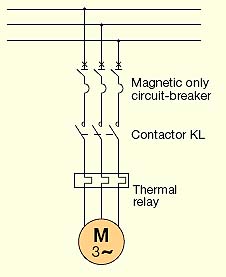
Рис. ABB
Схема прямого пуска электродвигателяMagnetic only circuit-breaker - Автоматический выключатель с электромагнитным расцепителем
Contactor KL - Контактор KL
Thermal relay - Тепловое реле
Параллельные тексты EN-RU
Direct-on-line starting
Direct-on-line starting, which is often abbreviated as DOL, is perhaps the most traditional system and consists in connecting the motor directly to the supply network, thus carrying out starting at full voltage.Direct-on-line starting represents the simplest and the most economical system to start a squirrel-cage asynchronous motor and it is the most used.
As represented in Figure 5, it provides the direct connection to the supply network and therefore starting is carried out at full voltage and with constant frequency, developing a high starting torque with very reduced acceleration times.
The typical applications are relevant to small power motors also with full load starting.
These advantages are linked to some problems such as, for example, the high inrush current, which - in the first instants - can reach values of about 10 to 12 times the rated current, then can decrease to about 6 to 8 times the rated current and can persist to reach the maximum torque speed.The effects of such currents can be identified with the high electro-dynamical stresses on the motor connection cables and could affect also the windings of the motor itself; besides, the high inrush torques can cause violent accelerations which stress the transmission components (belts and joints) generating distribution problems with a reduction in the mechanical life of these elements.
Finally, also the possible electrical problems due to voltage drops on the supply line of the motor or of the connected equipment must be taken into consideration.
[ABB]Прямой пуск
Прямой пуск, который по-английски часто сокращенно обозначают как DOL, является, пожалуй наиболее распространенным способом пуска. Он заключается в непосредственном (т. е. прямом) подключении двигателя к питающей сети. Это означает, что пуск двигателя осуществляется при полном напряжении.Схема прямого пуска является наиболее простым, экономичным и чаще всего применяемым решением для электродвигателей с короткозамкнутым ротором.
Схема прямого подключения к сети представлена на рисунке 5. Пуск осуществляется при полном напряжении и постоянной частоте сети. Электродвигатель развивает высокий пусковой момент при коротком времени разгона.
Типичные области применения – маломощные электродвигатели, в том числе с пуском при полной нагрузке.
Однако, наряду с преимуществами имеются и определенные недостатки, например, бросок пускового тока, достигающий в первоначальный момент 10…12-кратного значения от номинального тока электродвигателя. Затем ток двигателя уменьшается примерно до 6…8-кратного значения номинального тока и будет держаться на этом уровне до тех пор, пока скорость двигателя не достигнет максимального значения.
Такое изменение тока оказывает значительное электродинамическое воздействие на кабель, подключенный к двигателю. Кроме того пусковой ток воздействует на обмотки двигателя. Высокий начальный пусковой момент может привести к значительному ускорению и следовательно к значительной нагрузке элементов привода (ремней, крепления узлов), что вызывает сокращение их срока службы.
И, наконец, следует принять во внимание возможное возникновение проблем, связанных с падением напряжения в линии питания двигателя и подключенного к этой линии оборудования.
[Перевод Интент]
Тематики
Синонимы
EN
- across-the-line starting (US)
- direct line starting
- direct operation of a motor
- direct starting
- direct-on-line starting
- DOL
- full voltage starter application
DE
FR
пускатель прямого действия
Пускатель, одноступенчато подающий сетевое напряжение на выводы двигателя.
(МЭС 441-14-40)
[ ГОСТ Р 50030.4.1-2002 (МЭК 60947-4-1-2000)]
Пускатели переменного тока для прямого непосредственного пуска (с полным напряжением)
Пускатели, предназначенные для пуска двигателя, разгона его до номинальной скорости, защиты двигателя и подключенных к нему цепей от рабочих перегрузок и отключения питания двигателя.
[ ГОСТ Р 50030.4.1-2002 (МЭК 60947-4-1-2000)]EN
direct-on-line starter
a starter which connects the line voltage across the motor terminals in one step
[IEV number 441-14-40]FR
démarreur direct
démarreur qui applique la tension d'alimentation sur les bornes du moteur en une seule manoeuvre
[IEV number 441-14-40]Параллельные тексты EN-RU
Direct-on-line starters
Starters which connect the line voltage across the motor terminals in one step, intended to start and accelerate a motor to normal speed.
They shall ensure switching and protection functions as prescribed in the general definition.
[ABB]Пускатели прямого действия
Пускатели, одноступенчато подающие сетевое напряжение на зажимы двигателя и предназначенные для его пуска и разгона до номинальной скорости.
Кроме того, они должны обеспечивать коммутацию и защиту в соответствии с общим определением.
[Перевод Интент]Тематики
EN
DE
FR
эффект операционного рычага
эффект производственного рычага
Эффект операционного рычага - выражение того факта, что любое изменение выручки от реализации порождает изменение прибыли. Сила воздействия операционного рычага вычисляется как частное от деления выручки от реализации после возмещения переменных затрат на прибыль.
[ http://www.lexikon.ru/dict/fin/a.html]Тематики
Синонимы
EN
Англо-русский словарь нормативно-технической терминологии > DOL
-
18 aid
eid
1. noun(help: Rich countries give aid to developing countries; The teacher uses visual aids; He came to my aid when my car broke down.) ayuda, auxilio
2. verb(to help: I was aided in my search by the library staff.) ayudar, auxiliaraid1 n1. ayuda / auxilio2. ayuda / asistenciaaid2 vb ayudartr[eɪd]1 ayudar, auxiliar\SMALLIDIOMATIC EXPRESSION/SMALLin aid of a beneficio deto go to somebody's aid socorrer a alguien, acudir en auxilio a alguienwhat's all this in aid of? ¿a qué obedece todo esto?economic aid ayuda económicahumanitarian aid ayuda humanitariaaid ['eɪd] vt: ayudar, auxiliaraid n1) help: ayuda f, asistencia f2) assistant: asistente mfn.• acudimiento s.m.• amparo s.m.• apoyo s.m.• asistencia s.f.• auxilio s.m.• ayuda s.f.• ayudante s.m.,f.• favor s.m.• socorro s.m.• subsidio s.m.v.• abrigar v.• amparar v.• asistir v.• auxiliar v.• ayudar v.• favorecer v.• guarecer v.
I eɪda) u (assistance, support) ayuda fto come/go to somebody's aid — venir*/ir* en ayuda or (liter) auxilio de alguien
b) u ( monetary) ayuda f, asistencia fa concert in aid of... — un concierto a beneficio de...
what's all this in aid of? — (BrE colloq) ¿a qué viene todo esto? (fam)
c) c (apparatus, tool)teaching aids — material m didáctico
visual aids — soporte m (de material) visual
II
transitive verb ayudaraided by... — con la ayuda de...
[eɪd]to aid and abet somebody — ( Law) instigar* or secundar a alguien ( en la comisión de un delito)
1. N1) (=assistance) ayuda fto come/go to sb's aid — (lit) acudir en ayuda or more frm en auxilio de algn; (in argument) salir en defensa de algn
a neighbour rushed to his aid — un vecino corrió en su ayuda or more frm en su auxilio
•
a charity performance in aid of the blind — una representación benéfica a beneficio de los ciegoswhat's all this in aid of? * — ¿a qué viene todo esto?
•
with the aid of — con la ayuda deshe could only walk with the aid of crutches — solo podía andar con la ayuda or ayudándose de unas muletas
•
the star can be seen without the aid of a telescope — la estrella se puede ver sin necesidad or ayuda de un telescopio2) (economic, medical) ayuda ffood 2., legal 2.3) (=book, tool) ayuda faudiovisual, deaf 3., hearing 2., teaching 2., visual4) (=person) asistente mf2. VT1) [+ progress, process, recovery] (=speed up) acelerar; (=contribute to) contribuir a2) [+ person] ayudar•
to aid and abet sb — ser cómplice de algn; (Jur) instigar y secundar a algn3.VI ayudar4.CPDaid agency N — organismo m de ayuda
aid package N — dotación f de ayuda
aid programme, aid program (US) N — programa m de ayuda
aid station N — (US) puesto m de socorro
aid worker N — cooperante mf
* * *
I [eɪd]a) u (assistance, support) ayuda fto come/go to somebody's aid — venir*/ir* en ayuda or (liter) auxilio de alguien
b) u ( monetary) ayuda f, asistencia fa concert in aid of... — un concierto a beneficio de...
what's all this in aid of? — (BrE colloq) ¿a qué viene todo esto? (fam)
c) c (apparatus, tool)teaching aids — material m didáctico
visual aids — soporte m (de material) visual
II
transitive verb ayudaraided by... — con la ayuda de...
to aid and abet somebody — ( Law) instigar* or secundar a alguien ( en la comisión de un delito)
-
19 Konditionstrainer
■ Person, die für die Entwicklung und die Fortschritte in den Bereichen Ausdauer, Schnelligkeit, Sprungkraft und Kraftausdauer der Fußballspieler verantwortlich ist.■ Person responsible for developing the football players of a team in terms of stamina, speed, strength and athletic ability. -
20 resist
резист; фоторезист - Azoplate photo resist
- Azoplate resist
- carbonaceous resist
- deep-UV resist
- dopant resist
- dry-developed resist
- dry-film resist
- electron-beam resist
- electron-sensitive resist
- halide resist
- high-speed resist
- imaged resist
- large molecular weight resist
- metal etch resist
- multilayer resist
- multilevel resist
- near-UV resist
- negative-type resist
- negative resist
- non-liquid resist
- novolak-based resist
- optical resist
- photo resist
- photopolymer resist
- polysiloxane resist
- positive-type resist
- positive resist
- printed-circuit resist
- radiation-sensitive resist
- screenable resist
- self-developing resist
- slow resist
- ultraviolet-sensitive resist
- ultraviolet resist
- X-ray resist
- 1
- 2
См. также в других словарях:
Developing tank — A developing tank is a light tight container used for developing film. A developing tank allows photographic film to be developed in a daylight environment. This is useful because most film is panchromatic and therefore can not be exposed to any… … Wikipedia
Speed poker — is a live variant of Texas hold em inspired by online poker. A relatively new variant, it is the format of two major televised tournaments, the World Speed Poker Open and the Poker Dome Challenge, as well as the Asia Pacific Speed Poker… … Wikipedia
Speed reading — Jimmy Carter and his daughter Amy participate in a speed reading course … Wikipedia
Speed metal — Infobox Music genre name = Speed metal color = white bgcolor = #BB0022 stylistic origins = NWOBHM and punk rock [cite web|url=http://www.allmusic.com/cg/amg.dll?p=amg sql=77:782|publisher=Allmusic|title=Speed Metal.|accessdate=2008 06 07]… … Wikipedia
Speed bump — A speed bump (in British English a speed hump, road hump or sleeping policeman) is a velocity reducing feature of road design to slow traffic or reduce through traffic. A speed bump is a bump in a roadway with heights typically ranging between 3… … Wikipedia
Internet-Speed Development — What is Internet Speed DevelopmentInternet Speed Development is an Agile Software Development development method using a combined spiral model/waterfall model with daily builds aimed at developing a product with high speed.It was developed in the … Wikipedia
High-speed rail in China — This article is about high speed rail in the People s Republic of China. For high speed rail in the Republic of China (Taiwan), see Taiwan High Speed Rail. High speed rail (HSR) trains in China A China Railways CRH1 train in Guangzhou. CRH1 is… … Wikipedia
Need for Speed: Hot Pursuit (2010 video game) — This article is about the 2010 video game. For other uses, see Need for Speed: Hot Pursuit (disambiguation). Need for Speed: Hot Pursuit European cover art Developer(s) Criterion Games … Wikipedia
Need for Speed: The Run — Developer(s) EA Black Box Firebrand Games (3DS)[1] … Wikipedia
Need for Speed — This article is about the game series. For the first Need for Speed video game, see The Need for Speed. For other uses, see Need for Speed (disambiguation). Need for Speed Current logo. Genres Racing … Wikipedia
China Railway High-speed — 中国铁路高速 Locale People s Republic of … Wikipedia
